
For our Product Development Lab class (2019), our team of ten Industrial Design students was given the open-ended subject of Autonomous Vehicles (AV’s for short). Our challenge was to understand what needs to happen from a social point of view to incorporate autonomous vehicles into Boston’s mobility systems. With a 4 month timeline to present a deliverable, we conducted thorough research and landed in an interactive experience.

RESEARCH, ANALYSIS AND UNCERTAINTY
Prioritizing a scientific approach, we conducted over 25 extensive interviews on an
inclusive spectrum of subjects from different socio-economic classes, races, genders,
ages, careers, and home-base locations across the Greater Boston Area. Jon and I
led a focus group of 7 volunteers and all research results were analyzed collaboratively.
We visited sites like NuTonomy, BSA Space, Boston’s City Hall (MONUM office),
and the Daimler Experience at MIT’s Media Lab to have conversations with
professionals in the mobility industry. We concluded that experts were “open-minded”
about what the future of autonomous mobility could look like, but it was too ambiguous.
IDENTIFYING THE FINAL DELIVERABLE
We knew in order to make our project accessible to the broader Boston
community, the conversation about autonomous vehicles required wide appeal.
We decided to create a modular interactive installation and mocked it up in a classroom. Our vision was to present a refined version of the installation later on in public
spaces with a high traffic of people.

FINAL DELIVERABLE
We set up an event to invite members of the mobility industry as well as the general public to interact with the immersive experience as much as they wanted to. The idea was to raise questions, exchange thoughts, and continue the conversation around Autonomous Vehicles (AV’s).
The data acquired on the public’s wants, needs and concerns on this subject are invaluable to the development of AV’s technology, design, and human factors.
MY CONTRIBUTION
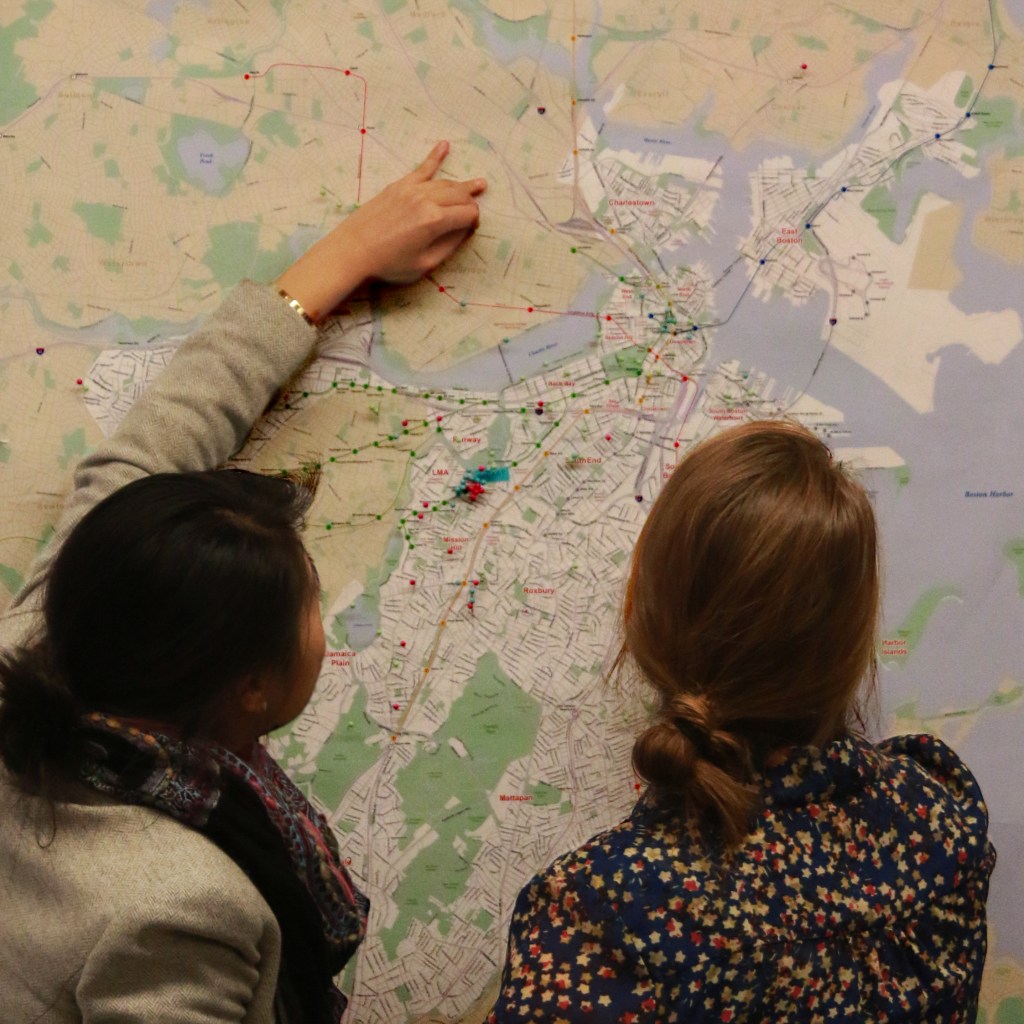
THE INTERACTIVE MAP
The was a map on the wall and there was a sign with groups of color-coded tacks attached
to it. The instructions read to “place a blue tack where you live, a red tack where you work, and a green tack where you frequent most for leisure”.
This activity would help people easily visualize a bird’s view of the Greater Boston Area and reflect how diverse their journeys are, how accessibility is impacted by proximity to public transit, and the contrasting transportation methods people use to commute was a huge part of the conversations, organically.
In retrospect, the color-coded tacks could have been non-inclusive for participants
with color-blindness as the green and blue did not contrast much. This could be fixed by
having tacks with different shapes.
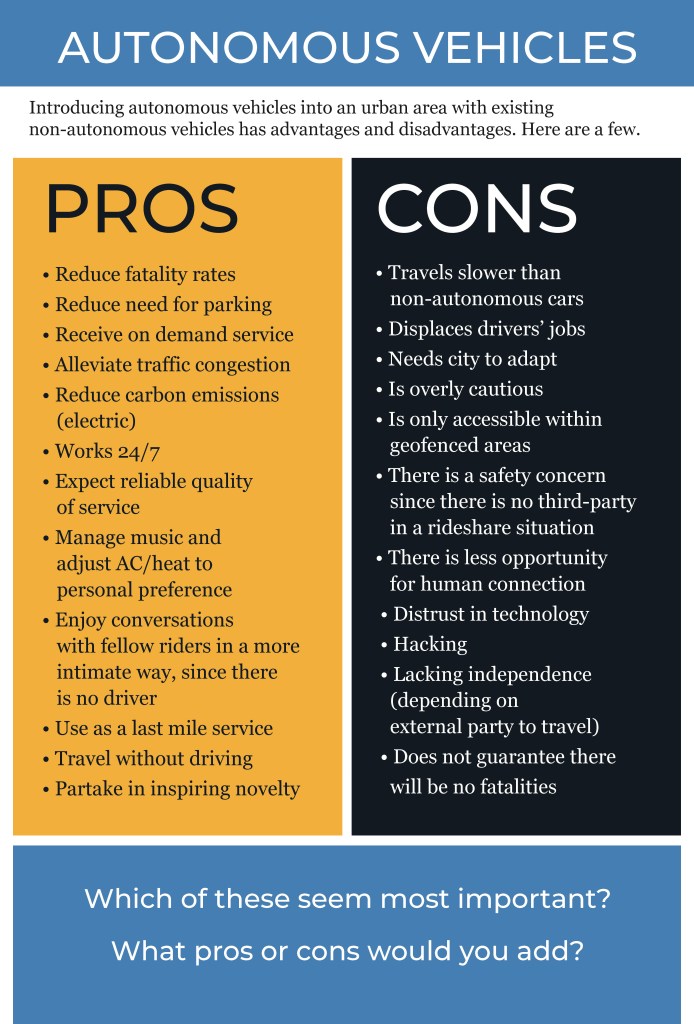
PROS AND CONS POSTER
This poster was meant to provoke contrasting thoughts, exposing
both sides of the possible implications autonomous vehicles could present.
In hindsight, I see the value in presenting the pro and con points more
cohesively so that each item could be directly compared with an opposing
idea more easily. Additionally, examples could have been provided
on some of the points to clarify the context.
QUESTIONS ACTIVITY
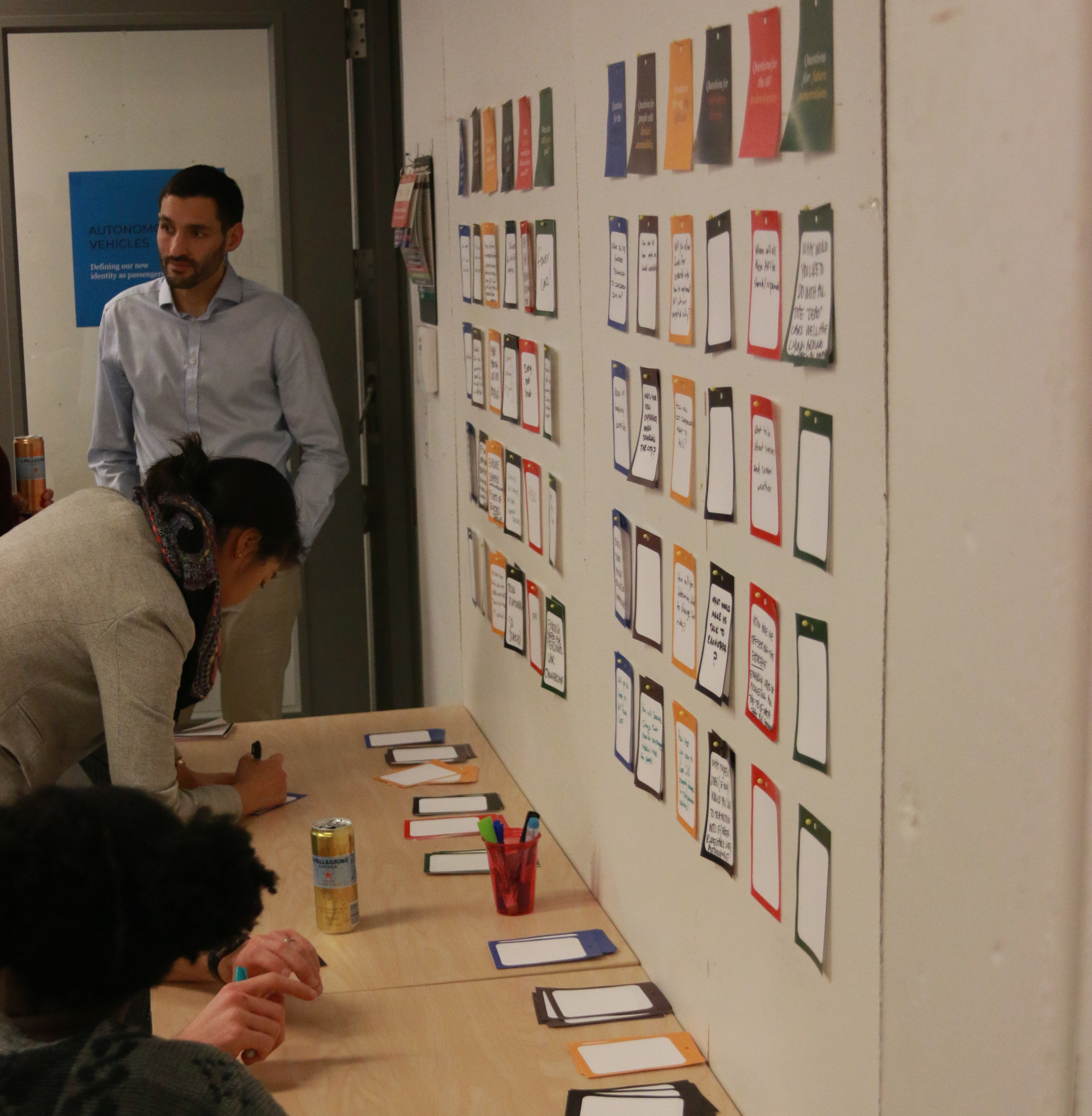
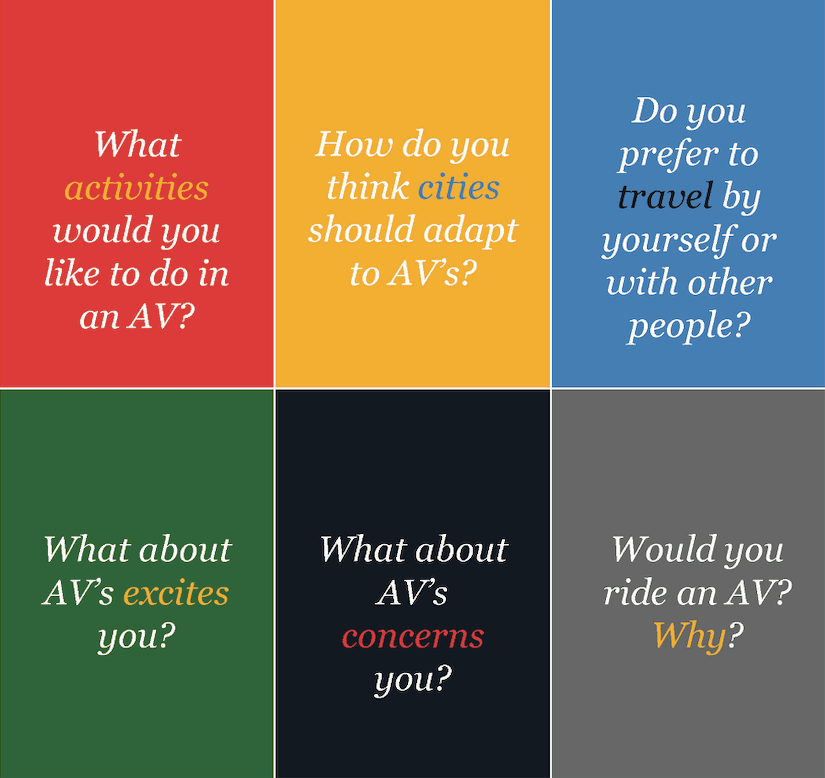
People would see two sets of six questions. One set was questions from us to them, asking about their opinions related to Autonomous Vehicles (AV’s). The second set was made up of questions directed from them to different entities. Placed on the table beneath, there were blank cards for each question with their respective colors and markers for everyone to use. Before the event started, we put up a couple of our own answers so the first people to interact were not intimidated by the “white canvas”.
People would hang their answers on the tacks beneath each question. This method would provide flexibility to layer answers on top of each other and move the answer sheets around to read them if they felt like it. People answered whichever questions they were interested in, giving them a platform to express their thoughts, doubts, and opinions by simultaneously providing us with valuable feedback and data.

THE TEAM’S CONTRIBUTION
DEBRIEFED INTERVIEWS AND PERSONA ACTIVITY
By Sina Seri and Jillian King
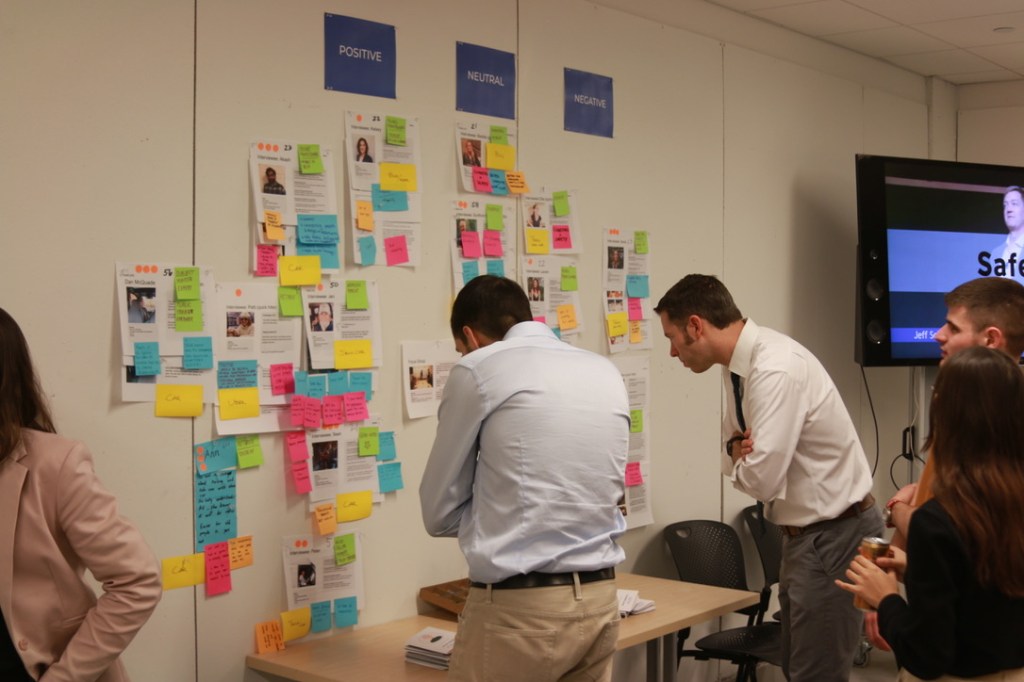
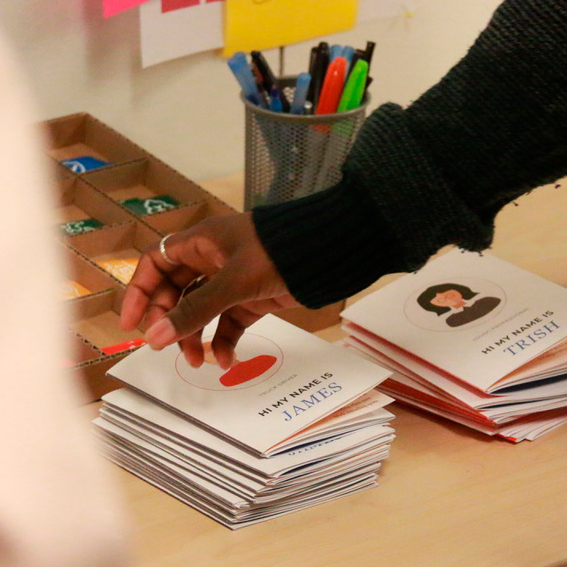
On the wall, we displayed our major insights from the interviews, showing what we learned about peoples’ opinions and concerns on AV’s. The Persona Activity consisted of booklets and stickers people could interact with and take home. With the booklets, they could create characters and think about their commutes, transportation methods, and possible needs when it came to AV’s.
SCALED CITY MODEL WITH A PROGRAMMED AUTONOMOUS TOY CAR
By Chiyang (Ian) Chang, Calder McCay, & Chongsheng (Howard) Zhao
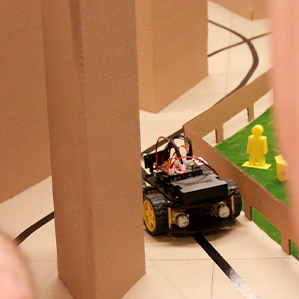
This part of the installation was meant to entice entice passerby, lured by a fun and dynamic 3D model. My teammates programmed the toy car to follow the black line along the road, avoiding obstacles and toy people that could be put on its way. Ideally the toy car would stop when it detected the line in front of it was being blocked, but that was not always the case. It was a great activity for people to gather around and watch or interact.
HISTORY OF MOBILITY INNOVATIONS POSTER
By Jon Chevrette, Alden Suokko, & Bradley Trepanier
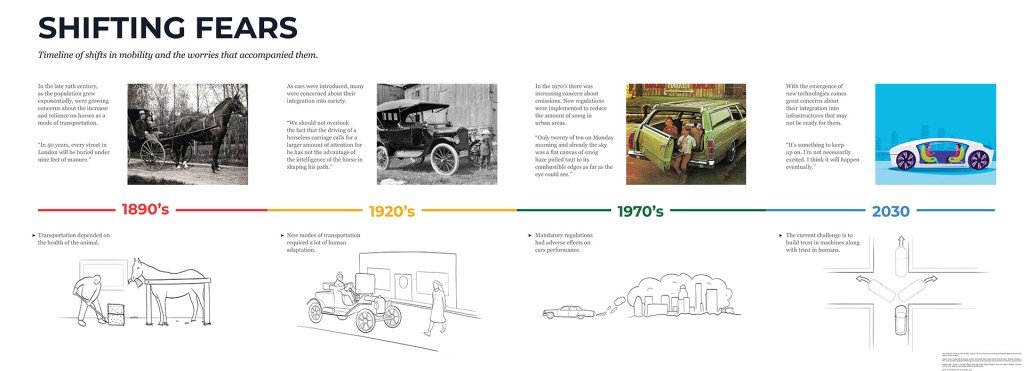
This poster illustrated how people have historically feared mobility innovation even though we now understand the value of these technological shifts.

WORK BREAKDOWN
| EDUCATIONAL VIDEO | Courtney Dipietro | cmdipietro@alumni.massart.edu |
| MOBILITY HISTORY POSTER | Jon Chevrette, Alden Suokko, & Bradley Trepanier | jhchevrette@alumni.massart.edu, assuokko@alumni.massart.edu, & bstrepanier@alumni.massart.edu |
| SCALED CITY MODEL AND PROGRAMMED AUTONOMOUS TOY CAR | Chiyang (Ian) Chang, Calder McCay, & Chongsheng (Howard) Zhao | cchang351@alumni.massart.edu, camccay@alumni.massart.edu , & czhao@alumni.massart.edu |
| PERSONA ACTIVITY | Jillian King & Sina Seri | jdking@alumni.massart.edu & sseri@alumni.massart.edu |
| MENTOR, NETWORKER AND PROFESSOR | Judith Anderson | janderson@massart.edu |
| INTERACTIVE MAP, PROS AND CONS POSTER, QUESTIONS ACTIVITY, AND EVENT SIGNAGE | Sabrina Sorondo | hello@sabrinasorondo.com |
 SABRINA SORONDO